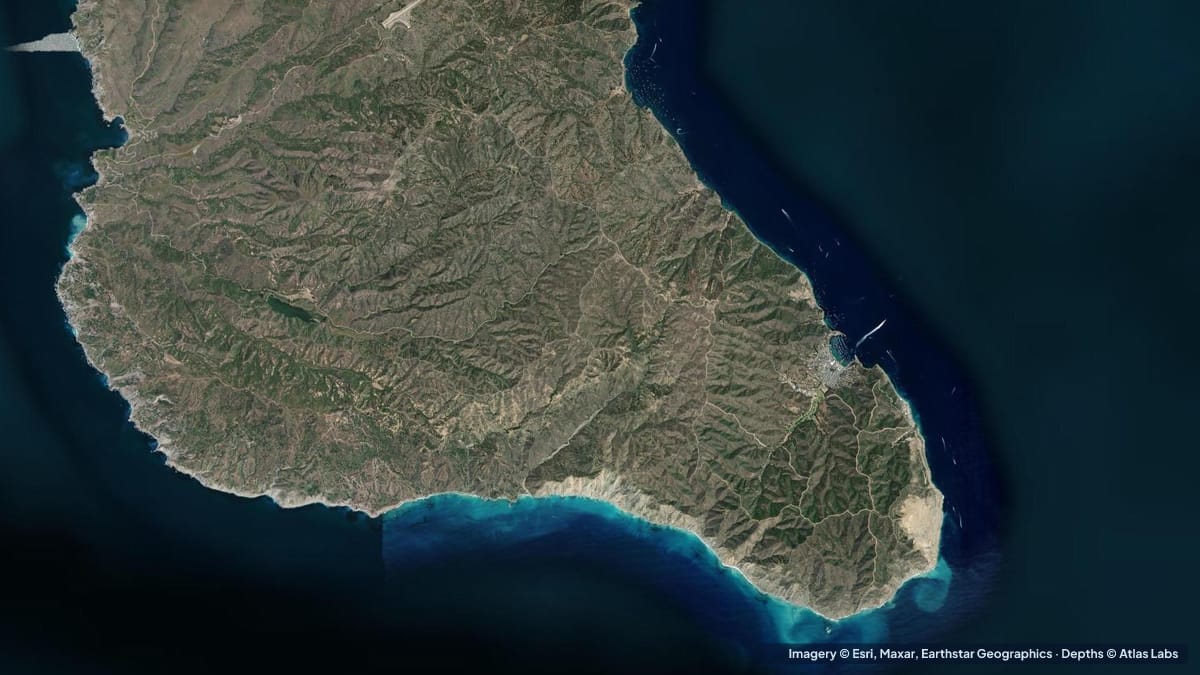
Two Harbors is the quiet end of Santa Catalina Island, about 22 miles (35 km) off the Southern California coast, where the island narrows to a half-mile isthmus between Isthmus Cove on the north side and Catalina Harbor on the south. Catalina has almost no shallow water: most coves go from a cobble or sand beach to 30 ft (9 m) within a stone’s throw. What it has instead is kelp forest, clear cold water, and dozens of small coves that are perfect for sea kayaking, snorkeling, freediving and spearfishing. This guide covers the Two Harbors area with typical depths, moorings, launches, conditions and hazards. The satellite depth map for this cell is updated regularly.
What the bottom looks like
- Isthmus Cove: a wide, north-facing cove with a pier, a dense mooring field, a sand and cobble beach and a sandy floor that slopes steadily to deep water. Kelp grows along the rocky edges.
- Catalina Harbor (Cat Harbor): the south-side harbour across the isthmus, one of the most protected anchorages on the island, with a mud and sand bottom and a mooring field.
- Little Fisherman’s Cove, Fourth of July Cove, Cherry Cove: small coves east and west of Isthmus Cove with moorings, kelp and rocky reefs; local descriptions note the island gets deep fast, with anchoring outside the moorings in 60 to 120 ft (18 to 37 m).
- Emerald Bay: a scenic bay to the west with Indian Rock in its middle, a small sand beach, kelp and a shallow area near the rock where boats anchor in roughly 6 to 10 ft (1.8 to 3 m), the closest thing to a shallow flat on this coast.
- Bird Rock and Ship Rock: offshore rocks with reef and kelp, popular dive and freedive sites.
- The West End and Parson’s Landing: wilder coast toward the island’s tip, with boat-in and hike-in camping at Parson’s Landing and kelp coves along the way.
Approximate depth by zone
Typical ranges only. The tide range is roughly 4 to 7 ft (1.2 to 2.1 m), which matters at the beaches and rocky entries. Check the live map.
- Isthmus Cove beach and dinghy landing: roughly 2 to 10 ft (0.6 to 3 m) in the first 50 yards, sand.
- Isthmus Cove mooring field: roughly 15 to 60 ft (4.6 to 18 m), deepening seaward.
- Catalina Harbor: roughly 10 to 30 ft (3 to 9 m) in the mooring field, shallower at the head.
- Little Fisherman’s Cove: slopes to roughly 60 ft (18 m) outside the moorings.
- Emerald Bay near Indian Rock: roughly 6 to 10 ft (1.8 to 3 m) in the sandy anchorage; the kelp reefs around the rock roughly 10 to 40 ft (3 to 12 m).
- Kelp coves along the coast: rock and kelp from roughly 10 to 60 ft (3 to 18 m) within a short distance of shore.
- Bird Rock and Ship Rock: roughly 20 to 100 ft (6 to 30 m).
- Offshore of the coves: 100 ft (30 m) and more very quickly, hundreds of feet in the channel.
Access, launches and moorings
- Ferry to Two Harbors: passenger ferries from San Pedro, with kayaks and dive gear carried for a fee; Two Harbors has a general store, a dive shop and kayak and paddleboard rentals on the Isthmus beach.
- Moorings: more than 700 moorings around the Two Harbors coves, assigned by the harbour patrol; anchoring is allowed outside the mooring fields at your own risk, in deep water with variable holding.
- Dinghy and kayak landing: the Isthmus Cove beach and the dinghy dock by the pier; Cat Harbor has a dinghy dock on the south side.
- Emerald Bay: a private camp with a public anchorage and a small beach; land only where permitted.
- Mainland ramps: Cabrillo Beach (San Pedro), Marina del Rey and Long Beach for trailerable boats making the crossing; the channel is 20 to 25 miles (32 to 40 km) of open water.
Best tide, wind and season
- Tide: Matters at rocky entries and the dinghy beach; otherwise the coves are deep enough that tide is secondary. Snorkel kelp at high tide for easier entry and more room over the rocks.
- Wind: The afternoon west-north-westerly builds most days from spring to fall and blows into the north-facing coves, including Isthmus Cove; Cat Harbor is the refuge. Santa Ana winds (fall and winter) blow offshore from the mainland and can make the north-side anchorages dangerous. Mornings are calm.
- Season: May to October for warm air and the most services, with water warmest (65 to 72 F, 18 to 22 C) in late summer and clearest in fall. Winter is quiet and cold with the best visibility some weeks and storms others. Lobster season (October to March) brings freedivers.
Hazards
- Deep water and cold: Water is 55 to 72 F (13 to 22 C); a wetsuit is needed most of the year and hypothermia is a real risk for kayakers who capsize.
- Afternoon wind: Kayakers heading west along the coast in the morning face a headwind coming back; plan to return by early afternoon or paddle out against the wind first.
- Boat traffic in the mooring fields: Dinghies, shore boats and arriving yachts; stay close to the rocks.
- Kelp entanglement: Snorkel and freedive with a buddy and a knife; keep fins free.
- Sea lions: Curious and sometimes aggressive in pupping season; give them space.
- The channel crossing: For boats only, in a weather window; fog is common in late spring and early summer.
Kayak and boat guidance
Sea kayaks and paddleboards (4 to 6 in, 10 to 15 cm of draft) can explore every cove from Isthmus Cove to Emerald Bay (about 5 miles, 8 km) and on to Parson’s Landing in the morning calm; this is open-coast paddling with cliffs, kelp and few landings, so carry a life jacket, a radio and a wetsuit, and stay in a group.
Yachts and powerboats drawing 3 to 8 ft (0.9 to 2.4 m) use the moorings; those anchoring outside need 60 to 120 ft (18 to 37 m) of water and plenty of scope. Only Emerald Bay near Indian Rock offers a genuinely shallow sandy anchorage in roughly 6 to 10 ft (1.8 to 3 m).
Frequently asked questions
How deep is Isthmus Cove at Two Harbors?
The beach shelves from roughly 2 to 10 ft (0.6 to 3 m) at the dinghy landing to roughly 15 to 60 ft (4.6 to 18 m) across the mooring field, and deeper outside.
Is there anywhere shallow to anchor at Catalina?
Very little. The best-known shallow spot near Two Harbors is beside Indian Rock in Emerald Bay, in roughly 6 to 10 ft (1.8 to 3 m) of sand. Most anchoring outside the moorings is in 60 to 120 ft (18 to 37 m).
Can I kayak around Two Harbors?
Yes, rentals are on the Isthmus beach and the coves to the west are a classic morning paddle. Return before the afternoon wind.
Where is the best snorkeling near Two Harbors?
The kelp edges of Isthmus Cove and Little Fisherman’s Cove, Emerald Bay around Indian Rock, and Bird Rock for stronger swimmers.
How cold is the water at Catalina?
Roughly 55 to 72 F (13 to 22 C) depending on season; a wetsuit is recommended for snorkeling most of the year.
Related reading
Safety note: ShoalScope depth maps are satellite estimates for planning only and are not for navigation. Catalina’s water is cold and deep, and kelp and afternoon wind are serious hazards. Use official charts, carry a radio, wear a wetsuit and a life jacket, and never dive alone.